
Quick Answer: For under $30, the Apera PH20 is the best value pH meter for cannabis growing. For under $100, the Apera PC60 (pH + EC + TDS in one) and the Bluelab pH Pen are both worth the upgrade. Avoid generic meters under $15 — their readings drift within days and will cost you more in dead plants than a quality meter ever would.
pH management is the most overlooked variable in a first grow, and the most commonly blamed for deficiency symptoms that are actually lockout symptoms. Cannabis can only absorb nutrients within a specific pH window — 6.0 to 7.0 in soil and 5.5 to 6.5 in coco or hydro. Water outside that range and the nutrients you are feeding simply become chemically unavailable to the roots, regardless of how much you add. The plant starves with a full plate.
A reliable pH meter is the tool that keeps your root zone in that window. A bad one gives you false confidence while your plants slowly decline. The difference in price between a cheap meter and a good one is under $40. The difference in outcomes is a full harvest.
This guide covers the best pH meter options at both price points, what separates reliable meters from unreliable ones, and exactly how to use and maintain whichever meter you choose.
Disclosure: WeedMania420 participates in the Amazon Associates Program. Purchases through our links may earn us a small commission at no extra cost to you. We only recommend products we have genuinely researched and believe in.
Table of Contents
What Makes a pH Meter Reliable
Before buying, understand the three things that actually determine whether a pH meter is worth using.
Accuracy Rating
pH meter accuracy is expressed as plus or minus a decimal value. A meter rated at ±0.1 pH could read 6.5 when the true pH is anywhere from 6.4 to 6.6. The Apera AI209 offers lab-grade ±0.01 pH accuracy at around $49 and is widely considered the best value in its class. For cannabis growing, ±0.1 is the minimum acceptable tolerance. Cheaper meters often advertise ±0.01 but deliver ±0.3 or worse in practice.
Calibration Stability
How long a meter holds its calibration between adjustments is the real-world performance indicator. Budget meters often require calibration every 2 to 3 days for best accuracy, while professional-grade meters typically hold calibration for 1 to 2 weeks with regular use. If you are checking pH daily during flower, a meter that drifts every two days adds significant maintenance overhead and buffer solution cost.
Probe Design
The glass electrode inside the probe is what actually measures pH. Cheaper meters use thin, fragile electrodes that degrade fast and cannot be replaced — when the probe fails, you buy a new meter. The Apera PH60 features a high-quality replaceable glass probe, meaning when the probe eventually degrades after 12 to 24 months, you replace just that component rather than the entire meter. On budget meters, plan to replace the full unit every 12 to 18 months.
The Best pH Meters Under $30
1. Apera PH20 — Best Budget Pick
Price: ~$22-28 | Accuracy: ±0.1 pH | Calibration: 2-point automatic
The Apera PH20 remains the top recommendation for most users due to its professional accuracy, waterproof construction, and reliable performance. The IP67 waterproof rating is meaningful — a meter that survives being dropped into a reservoir keeps working when most sub-$30 competitors stop. The automatic temperature compensation adjusts readings in real time as water temperature changes, so you get accurate readings whether you are testing cold RO water or warm nutrient solution from a recirculating system.
The calibration process is the simplest available — the meter automatically recognizes pH 4.0, 7.0, and 10.0 buffers, so there is no manual input required. Calibrate weekly and it consistently holds within 0.05 pH for 7 to 10 days between adjustments.
The PH20 is the right starting meter for any beginner and remains useful well into multiple grow cycles. The reading stabilises in 30 to 60 seconds, which is fast enough for daily watering checks without interrupting your routine.
Best for: First grows, soil growers, anyone who wants a reliable baseline meter at the lowest sensible price.
Pros:
- IP67 waterproof — genuinely drop-proof into liquid
- Auto-recognises calibration buffers, no manual adjustment needed
- Holds calibration 7 to 10 days between adjustments
- Automatic temperature compensation
Cons:
- Fixed probe — replace the whole unit when probe degrades (12 to 18 months)
- ±0.1 accuracy is sufficient but not lab-grade
👉 Check current price on Amazon.
2. VIVOSUN Digital pH Meter — Best for Absolute Beginners on the Tightest Budget
Price: ~$9-15 | Accuracy: ±0.1 pH claimed | Calibration: Manual 3-point
The VIVOSUN Digital pH Meter proves you do not need to spend a fortune for functional pH testing. At under $10, this meter offers 0.01 pH resolution, automatic temperature compensation, and a backlit LCD display.
The honest caveat: the VIVOSUN requires more frequent calibration than premium options, which adds to the ongoing cost of buffer solutions. Professional growers or those needing lab-grade accuracy should consider investing in a higher-end meter. Community testing has also found that readings can be off by 0.3 to 0.5 pH straight out of the box before calibration, and that calibration stability is poor compared to the PH20 at twice the price.
For a first grow where you want to understand pH management before investing more, the VIVOSUN does the job. Calibrate it before every single use and treat every reading as approximate within ±0.2. When it starts giving inconsistent readings (usually within 3 to 6 months of regular use), step up to the PH20 or PC60.
Best for: Absolute first-time growers on the tightest budget, or as a backup meter to cross-check a primary meter.
Pros:
- Lowest cost entry point for pH management
- Compact, backlit display
- Adequate for soil grows with careful calibration
Cons:
- Drifts quickly between calibrations — needs calibration every 2 to 3 days
- Real-world accuracy is ±0.2 to 0.3, not the advertised ±0.01
- Build quality is lightweight and less durable than other options
👉 Check current price on Amazon.
The Best pH Meters Under $100
3. Apera PC60 — Best All-in-One Meter
Price: ~$65-80 | Accuracy: ±0.01 pH | Measures: pH + EC + TDS + Salinity + Temperature
The Apera PC60 combines pH, EC, TDS, salinity, and temperature measurements in one pocket-sized device. Instead of juggling multiple meters, you get comprehensive water quality data from a single instrument. For hydroponic growers, this means monitoring both pH and nutrient concentration without switching tools.
The EC and TDS readings are particularly useful once you move beyond basic soil growing. EC (electrical conductivity) tells you the total concentration of dissolved nutrients in your water — a critical variable in coco and hydro grows where you are feeding every day. Checking pH and EC simultaneously at every watering is standard practice among experienced coco growers, and the PC60 makes that a one-step process rather than two.
The replaceable probe is a significant advantage over fixed-probe designs. When the probe eventually degrades after 12 to 24 months, you replace just that component rather than the entire meter. This extends the useful life of your investment and reduces electronic waste. The large LCD display uses colour-coded backlighting to indicate different measurement modes.
For growers following the autoflower nutrient guide where EC management is central to avoiding overfeeding, the PC60 pays back its cost in avoided mistakes within the first grow cycle.
Best for: Coco and hydro growers, serious soil growers who want EC tracking, and anyone planning to grow multiple cycles and wanting a meter that lasts.
Pros:
- pH + EC + TDS + temperature in one device
- ±0.01 pH accuracy — true lab-grade performance
- Replaceable probe extends the meter’s lifespan significantly
- Colour-coded backlit display is readable in low-light tents
Cons:
- Higher upfront cost than single-parameter meters
- If you only need pH, the simpler PH20 is better value
👉 Check current price on Amazon.
4. Bluelab pH Pen — Best for Long-Term Durability
Price: ~$75-85 | Accuracy: ±0.1 pH | Calibration: 2-point with sponge cap storage
The Bluelab pH Pen is the most widely used pH meter in professional cannabis cultivation. For commercial grows where multiple people calibrate and use equipment daily, the durability, brand support, and recognisable calibration process make it worth the premium.
The automatic temperature compensation works very well, and the Hold function lets you insert the pen into solution, press hold, and read the result in a comfortable position rather than leaning over a reservoir. The probe stores in a sponge-soaked cap that keeps the glass electrode hydrated between uses — the single most important maintenance feature on any pH meter. Storing a probe dry is the fastest way to destroy its accuracy permanently, and the Bluelab cap makes correct storage automatic rather than something you have to remember.
Community reports from serious home growers consistently describe 5 to 6 years of reliable use with proper care. One grower reported going on year 6 with their Bluelab pH pen — with proper care and handling they hold up well and are worth the money.
The one limitation to know: the Bluelab pen is rated at ±0.1 accuracy, the same as the budget PH20, compared to the ±0.01 of the Apera PC60. The Bluelab’s advantage is durability and fast stabilisation time, not raw accuracy. The Bluelab pH Pen offers exceptional durability and industry-standard calibration rather than maximum precision.
Best for: Growers who want a single meter that lasts years without fuss, experienced growers in hydro or RDWC systems checking pH daily, and anyone who values speed and build quality over all-in-one functionality.
Pros:
- Industry-standard durability — 5 to 6+ years with proper care
- Sponge-storage cap protects probe between uses automatically
- Fast stabilisation — readings in under 30 seconds
- Recognised and trusted across professional cultivation globally
Cons:
- ±0.1 accuracy, not ±0.01 — less precise than Apera PC60
- More expensive than the PC60 for less functionality
- Probe is not replaceable — when it goes, the unit goes
👉 Check current price on Amazon.
Quick Comparison
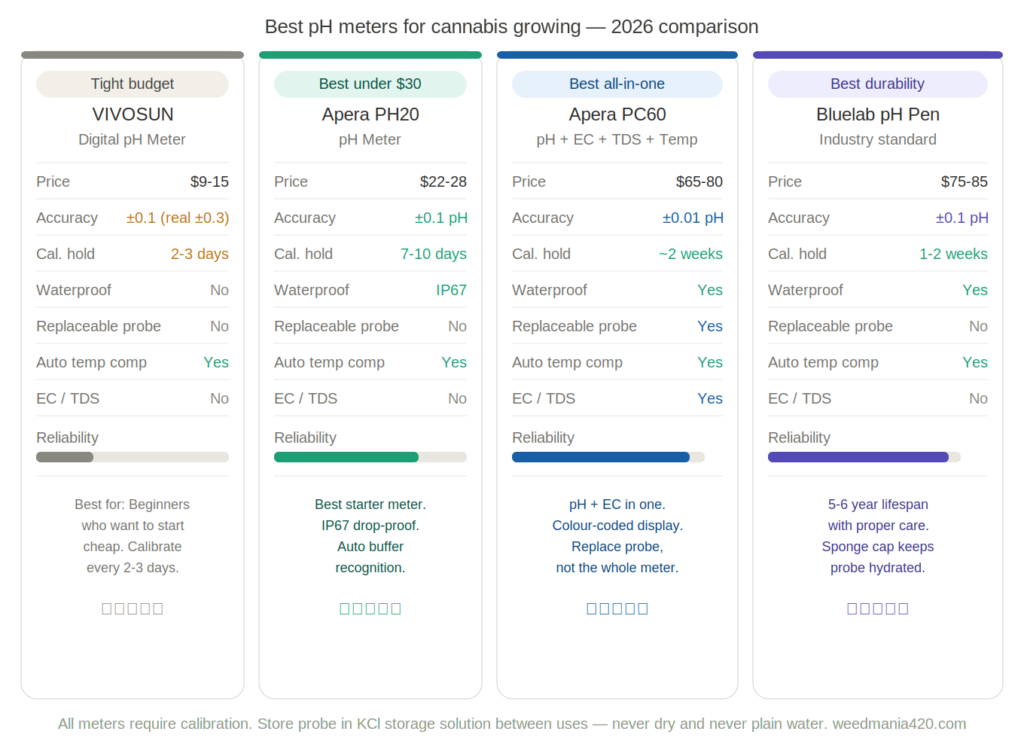
| Meter | Price | Accuracy | Replaceable Probe | Calibration Hold | Best For |
| VIVOSUN | ~$10-15 | ±0.1 (real-world ±0.3) | No | 2-3 days | Absolute beginners |
| Apera PH20 | ~$22-28 | ±0.1 | No | 7-10 days | Most beginners |
| Apera PC60 | ~$65-80 | ±0.01 | Yes | 2 weeks | Coco + hydro growers |
| Bluelab pH Pen | ~$75-85 | ±0.1 | No | 1-2 weeks | Long-term durability |
pH Targets by Growing Medium
The correct pH range shifts depending on your medium. Using soil pH targets in a coco grow will cause nutrient lockout even with a perfect feeding schedule.
Soil: Target 6.2 to 6.8 pH. The buffering capacity of soil tolerates a wider range than coco or hydro, but consistency within this window is still the difference between healthy growth and unexplained deficiencies. Check input water pH before every watering and runoff pH every two to three weeks.
Coco coir: Target 5.8 to 6.2 pH. Tighter window than soil. Coco binds calcium and magnesium at the root zone, so pH management is even more critical to keeping those nutrients available. Check pH at every single watering — coco growers who water daily are checking pH daily.
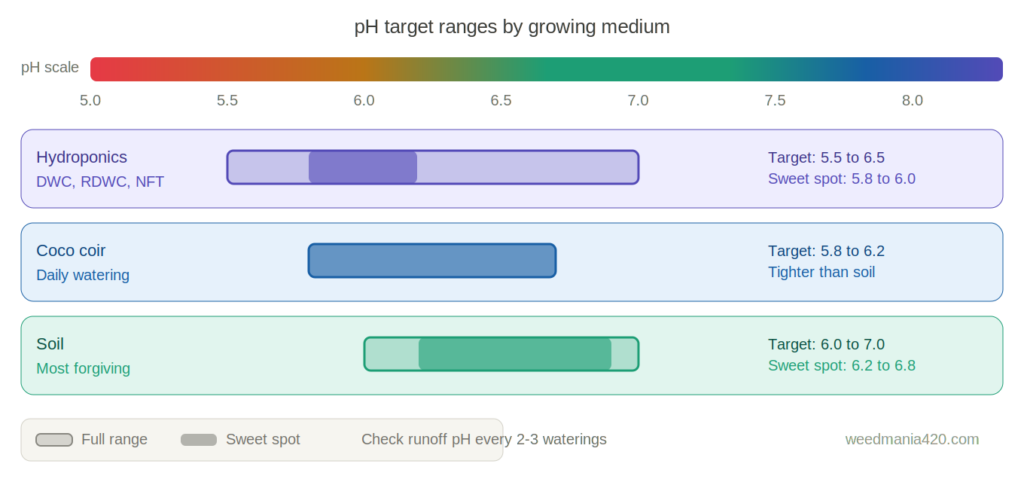
Hydroponics: Target 5.5 to 6.5 pH, ideally 5.8 to 6.0. The tightest window and the most punishing when drifted. RDWC and DWC growers check pH twice daily during peak growth periods.
Outdoors: Check your watering water before applying and adjust to 6.0 to 7.0. Outdoor soil has greater natural buffering, but a single week of watering with pH 8.0 tap water can lock out iron and manganese across the whole root zone.
How to Calibrate and Maintain Your Meter
Calibration is the one task that determines whether your expensive meter gives you accurate readings or expensive guesses.
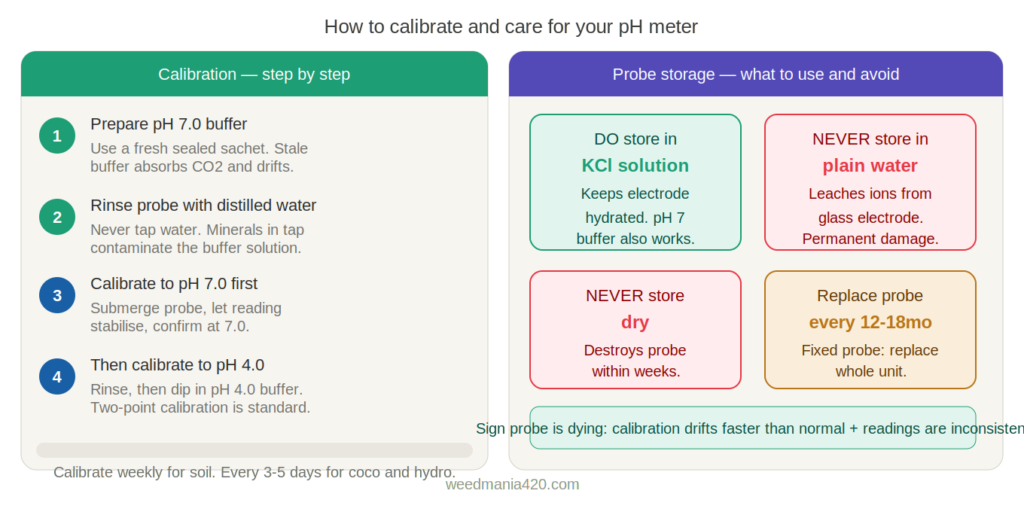
Calibrate with fresh buffer solutions. pH 7.0 buffer first, then pH 4.0 buffer. Always use fresh solutions from sealed sachets — buffer solution exposed to air absorbs CO2 and drifts from its stated value. Never reuse buffer solution after a calibration session.
Rinse the probe with distilled water between buffers and before measuring. Tap water contains minerals that contaminate the buffer solution and give false calibration readings. Distilled water or RO water only.
Store in a storage solution, never plain water or dry. Storing a probe in plain water leaches ions from the glass electrode and permanently damages calibration accuracy. KCl storage solution (sold separately or included with better meters) maintains the probe in the hydrated state it needs to function accurately. If you have run out of storage solution, pH 7.0 buffer is an acceptable temporary substitute. Dry storage destroys a probe within weeks.
Replace the probe on schedule. Glass electrode probes degrade regardless of how well you maintain them. On replaceable-probe meters, swap the probe every 12 to 18 months. On fixed-probe meters, replace the whole unit at the same interval if you notice calibration drifting faster than expected or readings becoming inconsistent.
pH Up and pH Down: What to Buy
A meter without adjustment solution is like a thermometer without a heater — it tells you there is a problem but gives you no way to fix it. Every grower needs both pH Up (usually potassium hydroxide) and pH Down (usually phosphoric acid).
General Hydroponics pH Up and pH Down is the most widely available and community-trusted option, available at most garden centres and on Amazon. A 1-pint bottle of each costs around $12 to $15 and lasts multiple grow cycles for most home growers.
Add pH Down or Up in very small drops — 0.5 ml at a time for small volumes, 1 to 2 ml for 5-gallon containers. Mix thoroughly after each addition and retest before adding more. Overshooting pH and chasing it back the other direction wastes time and solution, and can create pH swings that stress roots.
Signs Your pH Is Off
If you see any of these symptoms and your feeding and watering looks correct, check your pH first before adding more nutrients.
Interveinal yellowing (veins stay green while leaf tissue yellows, starting in older leaves): Likely magnesium lockout caused by pH below 6.0 in soil. The magnesium is there — the root zone simply cannot access it.
Brown spots on leaves, no pattern: Often calcium deficiency from pH drift in coco. Check runoff pH.
New growth pale or yellow: Iron or manganese lockout, most common when pH is above 7.0. New growth is affected first because these micronutrients support new cell development.
Nutrient burn symptoms despite low feeding: If you have not increased nutrients but see brown tips, check whether pH has dropped below 5.8, which can concentrate nutrient uptake of certain elements into toxic ranges.
For a full breakdown of symptoms by deficiency type, see our autoflower nutrient guide which covers deficiency identification alongside the feeding schedule.
What to Buy if You Are Just Starting Out
Start with the Apera PH20 at around $25 and a bottle each of GH pH Up and pH Down at around $12 to $15 each. That is a complete pH management setup for under $55 that will serve you through multiple grow cycles.
If you are growing in coco or hydro and plan to grow consistently, buy the Apera PC60 from day one. The EC readings will become as important as the pH readings within your first grow, and replacing the probe costs far less than replacing the meter when it degrades.
For the right seeds to grow with your newly calibrated setup, ILGM carries all major strains with a germination guarantee. Northern Lights and White Widow are two of the most forgiving strains for growers still learning pH management, with wide nutrient tolerance windows that give you room to develop your routine. See our 2×2 grow tent setup guide for the full equipment list to pair with your pH meter.
FAQ
What pH meter does GrowWeedEasy recommend? The GrowWeedEasy community consistently recommends the Apera line for value and the Bluelab pH Pen for durability. Both are reliable choices for home growing. Community discussion on the topic reflects strong support for both, with most experienced growers landing on whichever they bought first and maintaining it well.
How often should I calibrate my pH meter for cannabis growing? Calibrate weekly minimum for soil grows. For coco and hydro where pH is checked daily, calibrate every 3 to 5 days or whenever readings seem inconsistent.
Can I use a cheap $5 meter from Amazon? Not reliably. Sub-$15 meters typically drift by 0.3 to 0.5 pH within days of calibration and give false confidence. The $10 saving over an Apera PH20 is not worth the risk of a failed grow from consistent pH misreadings.
Do I need both pH Up and pH Down? Yes. Most tap water runs pH 7.0 to 8.5, which requires pH Down to reach the cannabis target range. pH Up is used less often but is needed when water is very soft (low mineral content) and runs acidic, and when pH has been over-corrected downward.
What is a good pH for cannabis seedlings? 6.0 to 6.5 in soil for seedlings. Start on the lower end of this range to minimise stress on undeveloped roots. See our 2×2 grow tent setup guide for the full environment targets by growth stage.